Charles Vaughan Johnson 1926-1998
An account of his life by his son Michael
Charles was born in Feb 1926 in Barnes, London. He was the second son of Muriel and Vaughan, and had an older brother Richard. Three years later the family was completed with another son, Henry.
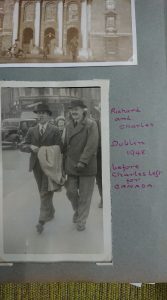
Dad never talked much about his early life. He was sent off to boarding school at Salisbury at the age of seven, where his elder brother was a chorister. Charles hated the experience of school, especially since it seems that Richard enjoyed school and did little if anything to help his younger brother to adjust. When Henry came to the same school a few years later, Charles vowed that he would take him under his wing and look after him. Henry was also a chorister, and Charles, being the only who wasn’t, probably felt left out. I think the experiences at Salisbury affected him for his whole life, and his relationship with Richard was never an easy one. He was always quite scathing about the English class system and English snobbery and I suspect that these feelings had an early origin.
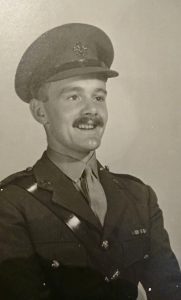
After Salisbury Charles went to King’s College Wimbledon. War was declared while he was there, and he remembered doing his senior matric exams during the Blitz and having at one point to complete the exam in a bomb shelter. The war was ending when he left school, and he joined the Fleet Air Arm to do his military service. While in the Fleet Air Arm he began his pilot training in Tiger Moths, but as far as I know he had not been certified as a pilot when he finished his service. For reasons which were never clear to me, there was a bureaucratic muddle which meant that he had no sooner finished his military service than he was called up again. I think he was perhaps quite glad to go into the Army because I don’t think he had any idea of what he wanted to do with his life. He served for a brief time in the Manchester Regiment.
After he was finally discharged he answered an advertisement and signed up for the Burma Police. This sounds odd, but it must be remembered that his father Vaughan had served during the First World war in Burma, the Andaman Islands and India. The stories he must have told about his time there no doubt had an influence on Charles. Maybe he was also keen to get away from England, which in the aftermath of the war was probably a place which didn’t seem to offer much in the way of opportunity for a young man, since many jobs were given to soldiers who had returned after demobilization.
Charles never went to Burma, though, because the job fell through when the Burma Police force was disbanded and Charles was given a small sum in compensation. He used the money to travel to Ottawa in Canada. I think this was because there was a connection with the Clutterbuck family, who I believe were neighbours in Walton on Thames where the Johnsons lived at the time. Sir Alexander Clutterbuck was the High Commissioner to Canada from 1946. I think there may have also been a romantic interest in Sir Alexander’s daughter, Anne Clutterbuck, but if so nothing came of it!
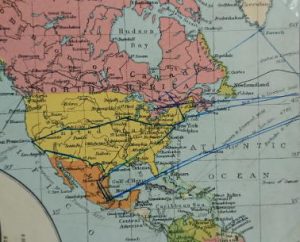
There is an account of Charles’s visit to Canada, and his holiday after that which took him to the USA and Mexico and his serendipitous meeting in Mexico with my mother Betty. Because he needed a job before he got married, Charles returned to England to take up a manager traineeship with Blue Circle Cement, no doubt thanks to the good offices of Kenneth Bannister in Mexico (who was Betty’s uncle by marriage, and the manager of Cementos Tolteca in Mexico). Having secured the job, Charles returned to Mexico to marry Betty, and the two of them then went back to England and settled for a while in Woodstock before moving to a bedsit in Gravesend, both locations being connected with the job at Blue Circle. I was born in Gravesend.
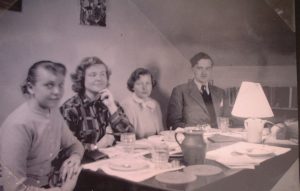
England in 1951 was not a cheerful place to be for a young and fairly impecunious family. Rationing was still in place, and the weather was discouraging for somebody who was used to the equable climate of Mexico City. My mother before her marriage had led a very easy life, enjoyed a lot of social activities, had her own car and lived in a comfortable house with a large garden and servants. Living in a bedsit in Gravesend with an infant, far away from family and friends, spending days on her own while Charles worked, coping with rationing and the weather, must have been difficult to say the least for both of them. It is hardly surprising that the small family got on a Holland America line boat in late 1951 and set sail for Mexico. The cargo ship ‘James Lykes’ took them to Galveston in Texas, where they were met by Betty’s parents in a car, and they all drove south to Mexico City.
Thus began a new phase in Charles’s life. Once again he was without a job. His father-in-law was wealthy but unsympathetic, and I know that Harold (“HS”) and Charles had a difficult relationship at this time. They initially lived with Dorothy and Harold at Comunal 52, which must have been difficult. I don’t know what Charles did in the first few years in Mexico. In a letter to his father from 1956 (at a guess) he refers to a sleeping directorship in Harold’s business, which surprised me when I read about it.
Charles eventually secured a job as a management trainee with British American Tobacco. He was sent on a training course to Louisville, Kentucky for two months, and then to Petersburg, Virginia for four months, presumably on an internship. The family joined him for part of the time in Petersburg. On his return to Mexico in 1957 he was posted to the El Aguila cigarette factory in the small town of Irapuato in the Bajio of Mexico. The family lived in a house in the company compound. There were large grounds and one other house in the compound, inhabited by an American family.
In September 1957 Vaughan, Charles’s father fell ill, and Charles travelled back to England. He was in time to say goodbye to his father, who died on September 23rd. It fell to him to notify his brothers and other family members of his father’s death.
Life in Irapuato was not easy either. It was a very small and provincial town, and there can’t have been much to do. Betty undertook to home school the boys, starting with Michael in 1957. There were occasional visits back to Mexico City, taking an overnight Pullman train. I don’t know what stresses and strains there were, but Charles quit his job in 1958, and the family moved to Guadalajara. Charles got a job working alongside a man called Hutchinson, who was in the import/export business. Unfortunately, Hutchinson proved to be a swindler of some sort, and in late 1958 the family packed their bags and drove back to Mexico City in the small green Fiat they owned.
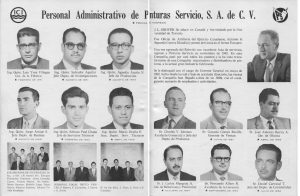
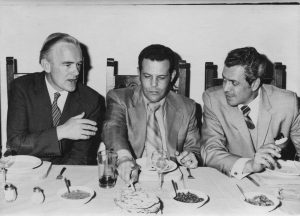
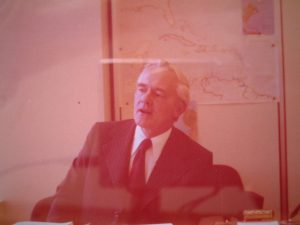
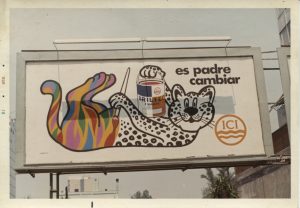
Once again unemployed, Charles cast around for a job, and landed a good one. He joined ICI Paints who were in the process of building a factory in Mexico. Charles enjoyed the work and became the Sales Director for Mexico, a post he occupied for many years. He brought home a good salary, and the family became more prosperous. He enjoyed corporate life and clearly performed well in it. There was one major snag: although he was a senior member of the management team at ICI de Mexico, he was a local hire. As such he did not enjoy the many and substantial perks which the expatriates, hired and sent out from England, enjoyed. These included tax benefits, medical benefits, paid travel for the family to the UK, etc. Most significantly of all, though, they included membership of the ICI pension scheme, and my father never succeeded in obtaining pension benefits, which was a source of great distress to him and my mother, especially as his time of retirement approached.
One advantage of being back in Mexico City was that better opportunities opened up for educating the boys. My parents did consider the possibility of sending us to boarding school in England, but Charles’s own experience of boarding school had been so damaging that he was determined if possible to spare his sons from that experience. The boys ended up going to a succession of small English-medium schools, and did their O level and A Level General Certificates of Eduction there without having to be sent away.
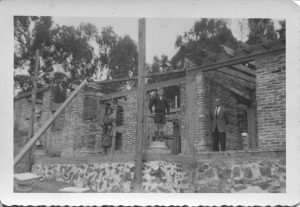
In the early 1960s Charles and Betty purchased a piece of land in the foothills of the mountains to the south west of Mexico City, and started building their dream house there. In 1964 they left rented accommodation behind and moved into their own house at 5696 Calzada Desierto de los Leones. That must have been a high point for Charles, since his own parents and grandparents had never owned the houses they lived in.
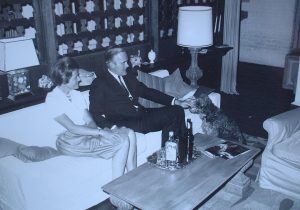
It seems to me that a major theme of my parents life and their relationship with each other is one of some kind of isolation. This seemed partly because their relationship was a strong one, and there was a sense in which they lived in a mythology of being self-sufficient within the bubble of their marriage. My mother was also very close to her mother, and in a sense her life revolved around her husband, her sons and her mother. Other relationships were not important, except where animals were concerned. Betty was always adopting stray dogs, and she loved the horses which my grandfather owned. I’m not sure about Charles. He participated in the mythology, but I think he was more gregarious than my mother. He truly enjoyed parties and social events. I think his relationship with his own mother and father had been less close, although maybe he did have a longing to re-connect with the family he lost because of boarding school, because of his emigration to Mexico and as a result of the death of his father.
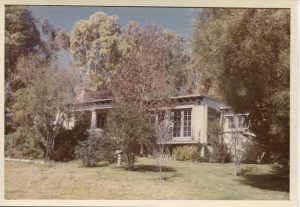
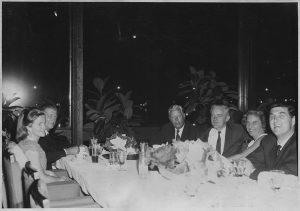
The house at Desierto de los Leones was wonderful in many ways, but it was also isolative. There was no real sense of a community there. Charles and Betty knew their neighbours and got along well enough with them, but were never close friends with any of them. They eschewed any contact with the Anglo/American ‘colony’ in Mexico, did not belong to any clubs or groups other than the riding club, they went occasionally to Christ Church services on a Sunday, but never went to the main Communion service, preferring the more austere and less well-attended 8.30 communion service. They gave that up after a few years. There was no television at their house, and more significantly, no telephone. There was little or no contact with my mother’s quite extensive family in Mexico, other than her parents and an uncle, Jimmy. It must have been a relief for Charles to immerse himself in the world of work, and I know he enjoyed the friendship of a lot of his colleagues. He occasionally intimated that he wished Betty were more sociable and willing to participate in and enjoy social gatherings connected with work. They did have some close friends, such as the Youngs, with whom they would have dinner and play and listen to music from time to time.
It is interesting that both Charles’s father and Betty’s father were quite active in their respective communities, especially in church-related activities. Vaughan had been a sidesman, and was a charity trustee. Harold was active in Christ Church (although less so than his wife Dorothy), he was a member of clubs such as the Reforma Club and the University Club, he was active in the British ex-servicemen’s association and was also a member of a masonic lodge. Charles became a member of the Toastmasters chapter in Mexico, and enjoyed learning to speak publicly, but other than this I’m not aware of his belonging to any group.
Charles’s feelings about his adopted country, Mexico, were complicated. He spoke Spanish, but never seemed to have made an effort to perfect his command of the language and his accent. He had good Mexican friends at work, but he always seemed prickly when dealing with Mexicans in ordinary settings. He gave the impression of believing that any Mexican speaking to him in a shop or giving him directions on the street was going to wilfully misunderstand him and was going to mislead him in some way. He hated the sun and the heat and always suffered when we went on holiday to places like Acapulco and Veracruz. At same time, he was glad to be free of Britain’s class system and snobbery, and appreciated that Mexico offered opportunities which perhaps would have been difficult to find in England. He got on well enough with the ex-pat colleagues at ICI, but was never especially friendly with them.
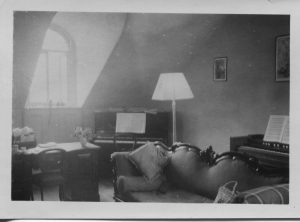
Charles may not have been a chorister at Salisbury, but he loved music, and was proficient at sight-reading. He played a variety of recorders, and also the piano. He and Betty used to play duets together with great verve. It was one of the pleasures which they shared throughout their life together. Charles was also keen on crafts. He did some painting when they lived in Gravesend, including some views of the Thames. He enjoyed woodwork, and later in life he took up copper enamelling. He also taught himself to weave and built himself a loom.
In 1977 Charles and Betty, after a lot of soul searching, put the house in the Desierto up for sale, and having sold it, they moved even further out of the City to Santa Rosa/San Mateo Tlaltenango. The plan was to release some of the capital stored up in the house, and they purchased a sizeable plot of land with a small house and a barn. The plan was to do up the house a bit and then sell it, and in the meanwhile to convert the barn into a large and creative living space. This was all eventually accomplished, with some dramas along the way, including being swindled by contractors, and living for a while in a house with no windows. The converted barn was spectacular and ahead of its time, since it was largely heated by passive solar power through large skylight windows, and it felt spacious and original.
Charles left ICI around this time (without a pension) and set up an import-export business called Manateos. Among other things it held the agency for a chemical company called US Bronze. I don’t think it was ever very successful. In 1979 Charles started his own paint business called Vinilica Blanca. This too failed to live up to expectation. In the meanwhile, Betty’s parents were ageing and increasingly unable to live on their own, so in 1988 Charles and Betty built another small house on their land, and Harold and Dorothy moved in. It became a full-time job to look after the pair, and ironically Harold, for all of his contempt for Charles at an earlier stage of his life, ended up being completely dependent on him.
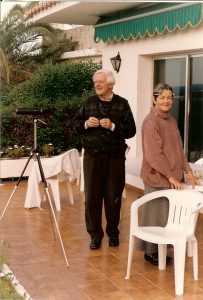
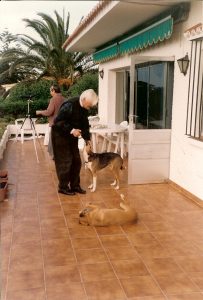
Harold died in 1990, followed by Dorothy in 1991, leaving Charles and Betty with decisions to make about where they proposed to live. They eventually decided to move to Spain, and sold their property in Mexico, leaving permanently in May 1993 with their two dogs, Bubbles and Sancha. After considering a number of possibilities in Southern Spain they ended up agreeing with their son Richard that they would built another storey on his house in Conil, which would be a self-contained flat.
Spain represented a compromise. Charles had long wanted to live in Europe, and Betty wanted to live in a Spanish-speaking country. Charles loved Spain, and was very happy there. He particularly loved going for long walks along the cliffs in Conil. He died rather suddenly and unexpectedly of a previously undiagnosed cancer of the pancreas in Nov 1998 in a hospital in Cadiz. He had specifically requested a non-religious funeral, and his ashes were strewn along his much-loved cliffs above the Atlantic Ocean.