Henry Johnson goes to Rhodesia
Henry Howard Vaughan Johnson 1929 – 1988
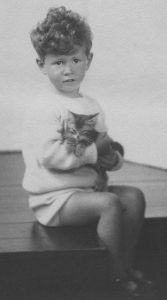
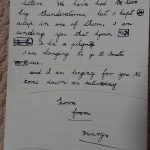
Dad was a chorister at Salisbury Cathedral. He was sent went away from his family home in London to be a boarder at the age of 8. The school was already attended by his older brothers – Richard (6 years older than him) and Charles (3 years older). Richard and Henry were choristers. The private schooling provided would have therefore been subsidised. This would have involved getting up extremely early every morning to sing morning song, various practices through the day as well as school and sport, and then again in the evening there would have been evensong. (I am only surmising this sort of timetable. I imagine it to be pretty grueling). I have attached a few letters that he sent home (click on letter shown above left).
In 1942, when he was about 13 years old (when their voices break) he attended Kings College, Wimbledon, joining his brother Charles. He started to learn the cello. Towards the end of WW2 Dad mentioned that one day a bomb dropped onto the school – and fortunately, it fell into the swimming-pool!
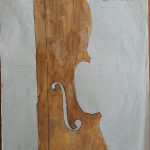
After leaving school he followed his brothers to Trinity College, Dublin where he had chosen to study archaeology and found himself with the other first year students some who were studying medicine. He felt out of his league and returned to London. He became an apprentice to a violin maker in the City. (Click the thumbnail at left to see the four drawings.)
One day, whilst walking to work, he got caught in a huge downfall of rain. He ducked into the nearest place for cover – and this happened to be Rhodesia House on The Strand. He stayed there an hour, and before he had left, he’d signed up either to be a bricklayer or a policeman in a country that he had no knowledge of…
Some weeks later a policeman came knocking on the family home door, asking for Henry. His mother was very concerned as to what he may have done, but it was actually a call for him to prepare to leave for Rhodesia as a policeman.
A month later he was on board ship. He was 21 years old.
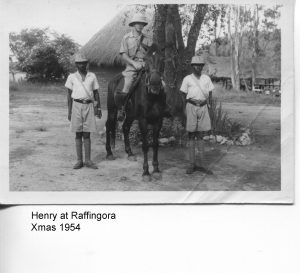
A month after arriving he was out in the bush, in the ‘middle of nowhere’, with a couple of black policemen, searching for a murderer.
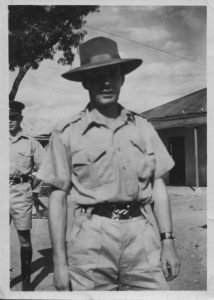
And so, he began his 20 years’ service for the BSAP (British South Africa Police) 1952 – 1972.
He was a District Policeman – which basically involved being sent to various obscure outposts all over the country. (I have some old letters which will give some history here)
Kariba (at the time of the Dam Wall being built)
One day he went to a fortune teller. He was told that he would meet his future wife over a ‘cup of tea’. He was very surprised at this, as beer would have been a more normal beverage!
He was a rowing crew member for the Police Force. They were rowing at Hunyani Rowing Club which was then based at Lake Mcllwanie. After a day’s racing he was lined up at the trestle tables getting his tea and cake. He was served by a beautiful woman, and he tried to ask her something, but she didn’t respond. He could not quite work out why. Finally, it transpired that she was completely deaf. She lip-read and she was there with her parents as her father rowed and they were members of the Club.
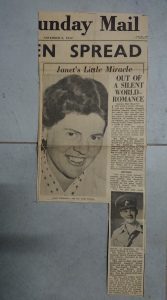
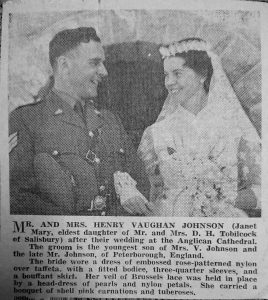
He had met Janet Mary Tobilcock.
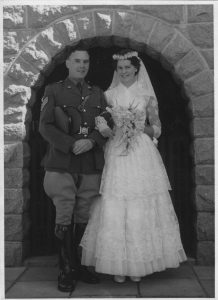
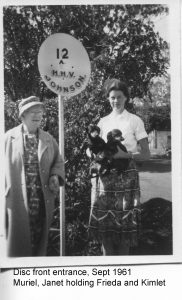
Janet found it very hard to lip-read him, and whilst out at a restaurant they would ask for extra paper napkins so that Henry could write down questions and answers. After he proposed and before they were married, in 1959 Janet was taken by her mother to England for 3 months, for her second European trip. On this visit they met up with Henry’s mother, Muriel Ivy Johnson.
They were married in Salisbury Cathedral 1st February 1960 with Eleanor (Janet’s sister) as her bridesmaid.
Their honeymoon was in Inyanga, in the Eastern Highlands
Their first home was a police house in Nyanyadzi, Umtali, in the Eastern Highlands of Rhodesia. They were there for 1 1/2years.
Colette Knowlden née Johnson