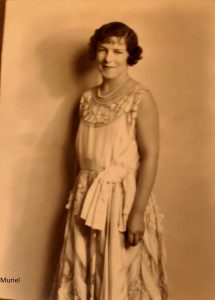
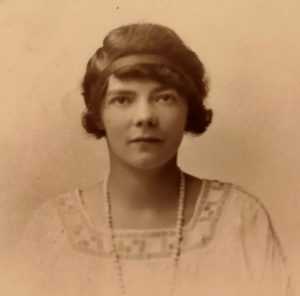
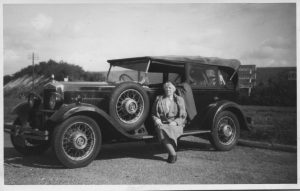
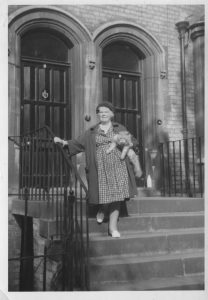
Muriel Ivy Johnson née Le Bas
‘Granny’ to Michael, Richard, Colette, Simon and Tessa
Muriel was born in Guernsey in 1891 at Les Blicqs in St Andrew’s Parish. Her mother, Marie Tostevin was a Guernsey woman and she married Philip John Le Bas, a Jersey man born in 1844. Marie didn’t like Jersey and they moved back to Guernsey. Her father died quite young, when Muriel was only three. Muriel was the youngest of eight children.
Les Blicqs belonged to Muriel’s brother Phil. When Phil got married Marie and her children Lucy, Herbert and Muriel moved to The Meadows. Marie died while living at The Meadows in 1911 when Muriel was only 19.
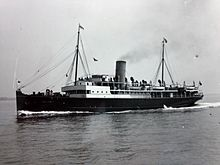
and the Channel Islands
During the holidays, at the age of 16 and 17 Muriel used to travel to the mainland on a packet steamer called the Caesarea. She would go to London where she stayed with her older sister Maude and her husband Winter Le Bas (who was also her cousin) at Glebe Place in Stoke Newington.
Another sister, Eunice, lived with Maude and Winter in Stoke Newington because Maude had been ill for a while following the birth of her daughter Muriel (known to Muriel Ivy as ‘Little Murie’) and Eunice looked after her. When she stayed in Stoke Newington Muriel would go to church at St Mary’s. (A century later Muriel’s grandson Michael and his wife Sherry paid for a stone carving in the church which is dedicated to Muriel’s memory.)
Muriel lived in Guernsey from 1911 to 1917. During the war her brother Herbert served with great distinction in the Guernsey Battalion (he was awarded the Military Cross in 1917).
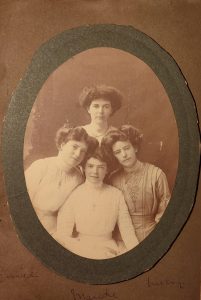
Eunice married Cuthbert Nevill and in 1917 and she wrote to Muriel suggesting that she come to London to do war work. Her father-in-law, Sir Walter Nevill would be glad to provide references. Muriel was delighted and came to London in her words ‘like a shot’. An unfortunate consequence was that her sister Lucy was left alone in Guernsey. Lucy was described as ‘delicate’ and was a pianist and a viola player. Muriel felt that Lucy never forgave her for leaving.
Muriel used to tell a story about her journey to London. She left Guernsey on July 26th 1917 on a misty morning on the TSS Roebuck* . Halfway to Weymouth they came out of fog into bright sunshine. The captain announced that a German submarine had been sighted, and there was panic on board. Muriel said that she saw the periscope, and then the wake of a torpedo which missed them. The Roebuck had a single gun which was fired at the submarine. Fortunately the submarine took no further action, and the Roebuck zig-zagged safely into Weymouth harbour. Muriel took the train to London and was met by Eunice. She said that she was extremely shaken up!
In London Muriel started work as a clerk at the Bank of England. She was working at the Bank in Threadneedle Street when there was a Zeppelin raid and a bomb was dropped outside Mansion House. Rather daringly for a new employee Muriel asked for a transfer, hoping possibly to be sent to Bristol. In the event she was transferred to the Western Branch in Burlington Gardens in the West End. She said she made a lot of friends there and settled in well. One friend kept talking about ‘a special friend who is in India’. One day everybody stopped work, and greeted the returning hero by singing ‘When Johnny comes marching home again’. The returning hero was the ‘friend from India’, Vaughan. He was introduced to Muriel and they became good friends. They eventually married in February 1921.
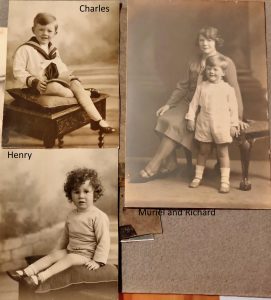
Muriel and Vaughan lived in Barnes where their three sons were born. Richard was born in 1922, Charles in 1926 and Henry in 1929. The three boys were sent off to boarding school as each reached the age of seven. By all accounts Vaughan was a kindly man, but he had firm views on what he expected from his wife, which included having dinner ready on the table at 7 every evening. It is said that Muriel never enjoyed cooking, and after Vaughan’s death in 1957 she did her best to avoid having to cook any meals at all!
Vaughan was posted for a while to the Bristol branch of the Bank, and the couple lived in Henlease during that time. On their return to London they moved into a large house in Walton on Thames.
After Vaughan died Muriel went to live with her eldest son Richard who had been ordained and was at the time the Precentor and sacrist at Peterborough Cathedral. She lived in the Close at Peterborough for five years, and then accompanied Richard when he was sent off to become the Rector in what was then Hartley, Rhodesia (now Cheguru, Zimbabwe). Muriel and Richard lived in Hartley for five years, but she didn’t really enjoy the life and climate in Rhodesia and returned to England and lived for a while in a flat in Bridport, Dorset, where she had friends. Richard returned from Rhodesia in 1972, and Muriel went again to live with him when he became assistant priest at King’s Worthy near Winchster. She spent the rest of her life living with Richard. They moved in 1973 to Littleton when Richard was appointed Rector of Littleton and Sparsholt and then to South Wonston when Richard retired.
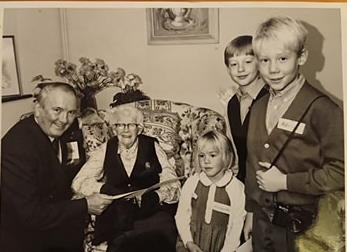
Muriel loved parish life and thoroughly enjoyed being the ‘vicar’s mum.’ She loved parties, and even after her eyesight failed she would recognise each parishioner by their voice and always had an apposite question about their family or their doings. She and Richard would go out for drives in the country or very often down to Southampton to see the ships and watch the boats on the Hamble. Her grandchildren often wondered how she and Richard managed to avoid gastric illnesses given the chaotic nature of the kitchen at the rectory and the cavalier approach to cooking and culinary cleanliness adopted by both of them. They ate out quite a lot, giving themselves treats by going to motorway service cafes. Anybody visiting the rectory over the weekend was expected to provide meals for their stay, with the occasional treat of lunch at a local pub.
Muriel celebrated her 100th birthday in South Wonston. Although she had lost her sight, she continued to have a great zest for life. As her needs increased she was cared for by Richard and had daily visits from professional carers. Two weeks before she died on October 5th 1992 she went into a nursing home because it was no longer possible for her needs to be met at home.
Michael Johnson, May 2020. I have based my account on notes taken after a conversation with Granny on Sept 4th 1983, supplemented with facts recorded by Richard for a newspaper article on Granny’s 100th birthday.