Johnson paternal line
Table of Contents
William Johnson and Sarah
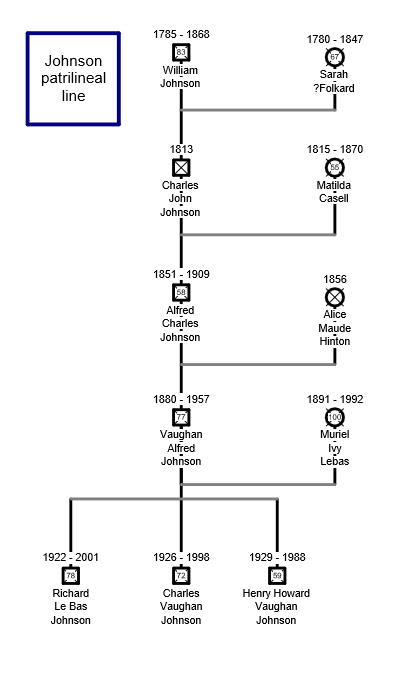
Our branch of the Johnson family tree goes back as far as about 1785, when William Johnson was born. We don’t know exactly when or where he was born, but the 1851 and 1861 census suggest that he was born in Ufford, Suffolk, around 1785. The censuses are not completely trustworthy and often contain approximations especially of age, and also of spellings. There is an Ufford in Suffolk, although the it could also be Orford, which was a diocese in Suffolk.
We don’t know a lot about William. He married someone called Sarah possibly in 1807 or 1808, and in 1809 they were living in Croydon and gave birth to a son, Daniel William. Daniel died at the age of seven. A daughter, Sarah Susanna was born in 1812 and another son, Charles John was born in 1813. The three children were baptised at St John the Baptist, Croydon.
William seems to have lived most of his life in Croydon. We know that in 1838 he was an auctioneer by profession (marriage certificate of CJ Johnson and 1841 census). In 1851 and 1861 he was living at 29 Church Street, Croydon. The 1861 census gives “furniture dealer” as his occupation. Sarah Susannah (who at some point added the ‘h’ to Susannah) apparently never married, and lived with her parents while they were alive. William’s wife Sarah died in 1847 and was buried at St John’s, Croydon. William himself died in Croydon in 1868, we think, but place of burial is not clear.
Charles John Johnson and Matilda Cassell
Charles John was William and Sarah’s third child and second son, born in 1813 at the time of the Napoleonic Wars. He was married in 1838 at the age of 25 to Matilda Cassell. The wedding took place at Bethnal Green Parish Church, and his aunt Sarah Susannah was one of the witnesses. His occupation is shown as ‘Auctioneer’ (as was his father’s).
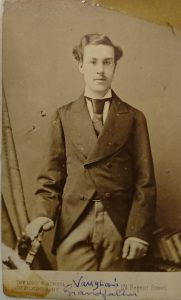
Charles and Matilda moved around quite a lot. The 1841 census has the young family living in Dover. In 1851 they were living in William Street, Islington. In 1861 and 1871 they were living in Norfolk Square, Paddington.
Between 1839 and 1855 they had 10 children. The third, fourth and sixth children died in early infancy. Alfred Charles was born in 1851 and was the eighth child and first son to survive infancy. We have the flyleaf of a Bible which lists all of the children and the dates of their birth. This helps to confirm other data such as what the census tells us.
Charles John may have moved up in the world. By the 1851 census his occupation is ‘accountant’. It seems he was wealthy enough to send at least one of his sons, Frank, to an expensive public school (see below). In the 1871 Census he is shown as ‘Accountant to solicitor’ and has two servants in his household. He was living at that time in Paddington.
When his son Alfred Charles was married in 1878 Charles John is listed as ‘Clerk in a Solicitor’s Office’ which seems like a bit of a come-down in life! I haven’t been able to find him in the UK Articles of Clerkship 1756-1874.
Things seem to have gone awry for Charles John in 1871. In April of that year we find him being declared bankrupt (notice in the Daily News of Apr 27th 1871) and his death notice in The Standard of 26th May 1876 shows him living at the time in Maida Hill. He probably died a disappointed man.
Matilda’s family, the Cassells, were Huguenots. There is some archival material relating to this part of the family because it was of particular interest to Uncle Richard (Richard Le Bas Johnson).
Alfred Charles Johnson and Alice Maude Hinton
Alfred Charles was the eldest surviving son of Charles John and Matilda, despite being the eighth in birth order. He was born in Islington in 1851, and the census records him as living with his parents in Paddington in 1861. We don’t know where he went to school, but it seems his younger brother Frank was at Cranleigh, a boarding school in Surrey, in 1869.
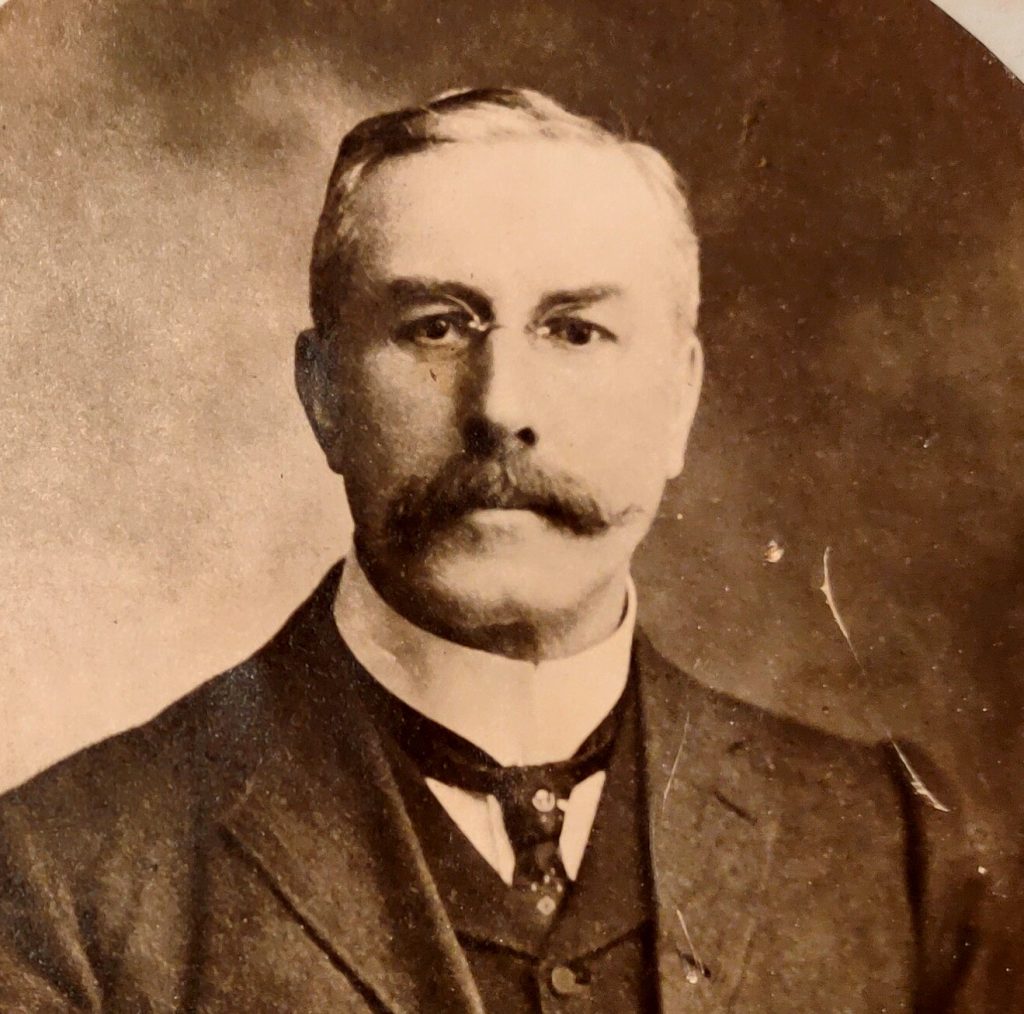
Alfred Charles married Alice Maude Hinton in 1878, at the parish church of St Alban The Martyr in Holborn. According to the marriage certificate he was a ‘Clerk in a Brewery’ at the time. In the 1881 census he is still a clerk in a brewery. In the 1891 and 1901 censuses he appears to have worked for an encaustic tile manufacturer.
Alice Maude’s father was a doctor who lived at 12 Doughty Street. The name ‘Vaughan’ which has appeared many times in our family comes from the Hinton side. The Hinton family are related by marriage to the Jenkinson family who have South African connections and were therefore of particular interest to Uncle Richard. The Jenkinson family is related by marriage to another Johnson family who are, as far as we know, unconnected to us. Archdeacon Charles Johnson was a missionary in Zululand and his name and picture crop up in many of the family photo albums.
The Alfred Charles Johnson family seems to have also moved around quite a lot. At the time of his marriage Alfred C was living at 26 Brooke St. In 1881 they were living in Mecklenburgh Square, in 1891 they were in Brixton Hill, Streatham, in 1901 at 3 Purcell Mansions, Fulham. In the 1905 electoral register he is living at 56 Abingdon Road, Earl’s Court, Kensington.
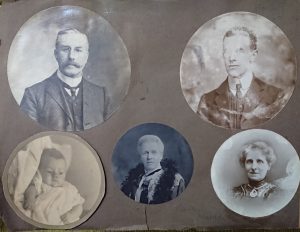
Vaughan as a baby, and possibly two siblings
The 1851 census (the year Alfred C was born) shows Alfred C’s older sister Marian, aged 5, visiting her grandparents in Croydon, although her name is misspelled as Mary Ann.
Alfred Charles and Alice Maude had three children: Vaughan Alfred, John Graham and Hylda. Vaughan has his own section below. John Graham married Hilda Old in 1911, and it would seem they moved to Canada not long after. They lived for a while in Calgary, and later in Victoria. John Graham fought in WW1, in a Canadian regiment, and was wounded as the result of an accident. He was sent back to Canada and discharged. His Attestation Papers are available in the Ancestry.co.uk archives.
Hylda married Herbert Graham Foxwell, and they had two children, Joyce and John. The Foxwells and the Vaughan Johnsons seem to have been quite close, going on holidays together and appearing in a lot of snaps.
Alfred Charles died fairly young at the age of 58. According to Muriel Ivy, his death left the family ‘high and dry’. This may have been history repeating itself, since a similar thing seens to have happened with his father.
Vaughan Alfred Johnson and Muriel Ivy Le Bas
Vaughan was born at 31 Mecklenbergh Square in 1880. According to Muriel Ivy he was suposed to attend boarding school at Cranleigh, where his uncle Frank went, but the family wasn’t wealthy enough to send him. By the age of 21 he was working at the Bank of England, where he worked most of his life when he wasn’t doing military service. In 1907 he was admitted into The Honourable Artillery Company which is a part-time reservist regiment. His father died in 1909 and the 1910 electoral register shows him living with his mother in Earl’s Court. The following year they moved to Barnes.
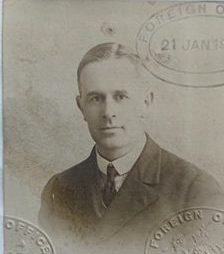
In October 1914 Vaughan was commissioned as a second lieutenant in the Territorial Army. He was sent to Burma and to the Andaman Islands, and by the end of the war he was in India. By 1918 he was a Lieutenant and was an army Inspector of Accounts based in Bombay. After the war he returned to his job as a clerk at the Bank of England where he met Muriel Ivy Le Bas, a young woman from Guernsey who had been doing war work at the time as a temporary clerk at the Bank. Vaughan and Muriel were married at St Stephen’s Church, Ealing, in February 1921. The couple lived in Barnes, and had three sons, Richard (Aug 1922), Charles (Feb 1926) and Henry (1929). Vaughan was 42 when Richard was born, and 49 when Henry was born. Muriel was 11 years younger.
Vaughan was clearly quite sociable and seems to have belonged to various groups. For example, he played on one of the Bank of England hockey teams. He was elected a member of the National Geographic Society in 1923.
The three sons were sent off to boarding school as each one reached the age of seven. They went to prep school at Salisbury, where Richard and Henry were choristers. Richard went on to King’s College Taunton, while Charles and Henry went to King’s College Wimbledon. The last years of Charles and Henry’s schooling was disrupted to some extent by the war. Richard joined up and spent part of the war in Mesopotamia. He wrote regularly to his parents and the letters are archived at the Imperial War Museum.
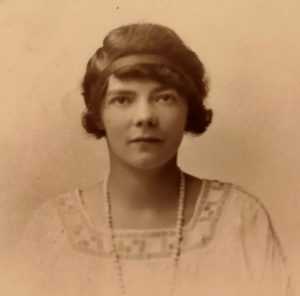
In the 1940s Vaughan and Muriel moved from Barnes to Walton on Thames, where they rented quite a large house which was known as ‘Cassell.’ Vaughan was a volunteer fire warden for the area during the blitz. He was a sidesman and member of the PCC at St Mary Oatlands. He was a local school governor and Secretary of the Walton Poor’s Charities.
Vaughan died in September 1957, apparently of a coronary thrombosis.